HDPE gas pipe is widely used in natural gas distribution and other selected oil and gas applications where corrosion resistance, flexibility, reliable joints and long service performance are important.
Manufactured from high-density polyethylene materials such as PE100 or PE4710, HDPE pipe provides a lightweight alternative to traditional metallic piping for many buried gas distribution systems. Its corrosion resistance, flexibility and heat-fusion joining technology can simplify installation while providing a continuous pipeline system with strong, leak-resistant joints.
For oilfield and industrial applications, HDPE pipe selection must be based on the transported medium, operating pressure, temperature, chemical compatibility, pipe dimensions, applicable standards and local regulations. HDPE should therefore be specified for each application rather than treated as a universal replacement for steel pipelines.
Unlike conventional steel pipelines, polyethylene does not rust or suffer from electrochemical corrosion.
This makes HDPE particularly suitable for buried gas distribution systems and selected applications where the surrounding soil or operating environment may create corrosion challenges for metallic pipes.
HDPE is also resistant to many chemicals. However, chemical compatibility should always be confirmed for the specific transported fluid, concentration, temperature and operating conditions before an oilfield application is specified.
HDPE pipe has high flexibility and impact resistance compared with many rigid pipe materials.
Its flexibility allows the pipeline to accommodate certain ground movements and changes in terrain, making it suitable for many buried pipeline installations.
For projects involving seismic movement, settlement or difficult ground conditions, the complete pipeline design should consider pipe flexibility, installation conditions, jointing method and local engineering requirements.
HDPE pipe can be joined using butt fusion and, depending on the pipe and fitting system, electrofusion.
When properly prepared and fused according to the applicable procedure, the pipe and fitting form a continuous polyethylene joint.
This reduces the number of conventional mechanical joints and can help minimize potential leakage points.
Proper fusion requires qualified procedures, suitable equipment, clean pipe surfaces, correct heating parameters, alignment and adequate cooling time.
High-performance polyethylene materials such as PE100 and PE4710 are designed for long-term pressure applications.
Actual service life depends on material grade, pipe dimensions, operating pressure, temperature, installation quality, transported medium and applicable design standards.
For this reason, a project-specific design life should be established rather than assuming one service-life value for every HDPE application.
HDPE pipe is significantly lighter than many metallic pipe systems.
The relatively low weight can simplify transportation, handling and installation, particularly on projects where access is difficult.
Depending on project conditions, HDPE pipe may also be installed using trenchless techniques such as horizontal directional drilling or pipe bursting.
The relatively smooth internal surface of polyethylene pipe can provide favorable hydraulic characteristics and reduce the potential for internal deposits compared with rougher or corroded pipe surfaces.
Actual flow performance depends on pipe diameter, wall thickness, flow conditions, fluid properties and system design.
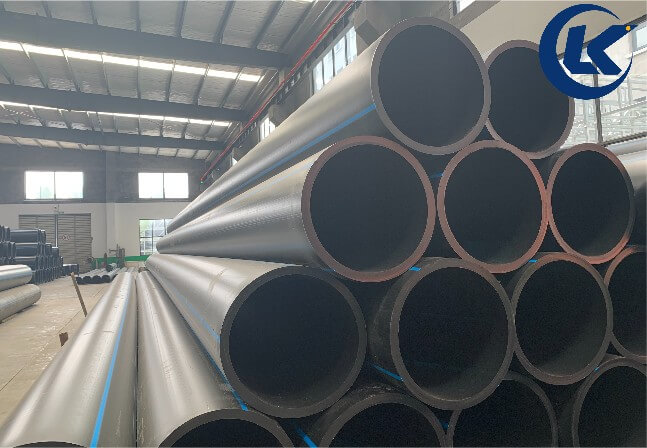
Natural gas distribution is one of the most established applications for polyethylene gas pipe.
HDPE gas pipe can be used for buried mains and service lines in residential, commercial and industrial gas distribution systems where permitted by the applicable standards and regulations.
The ISO 4437 series specifically covers polyethylene piping systems for the supply of gaseous fuels. ISO 4437-2 addresses PE pipes, while the series also covers fittings, valves and system requirements.
PE pipe may be considered for selected gas gathering applications where pressure, temperature, gas composition, pipe size and regulatory requirements are compatible with polyethylene pipe.
The engineering design should evaluate the complete operating environment before selecting HDPE.
HDPE pipe can be considered for selected oilfield utility and service applications, including certain water, gas and other non-metallic piping systems.
For hydrocarbons and produced fluids, material compatibility must be evaluated carefully because the suitability of polyethylene depends on the specific fluid composition, temperature and operating conditions.
HDPE pipe is widely used in water-related industrial applications because of its corrosion resistance and fusion-jointed construction.
In oilfield environments, HDPE may be considered for selected produced-water handling, water transfer and injection-related applications when the operating pressure, temperature and chemical environment are suitable.
HDPE may be suitable for selected utility services around industrial facilities and petrochemical sites.
However, it should not be presented as a universal replacement for steel process piping. Process-fluid compatibility, temperature, pressure and applicable plant standards must be reviewed before specification.
Our HDPE gas pipe can be manufactured according to project requirements and applicable international standards.
Typical product configurations may include:
| Item | Typical Specification |
|---|---|
| Material | PE100 / PE4710 |
| Standard | ISO 4437 and applicable national standards |
| Diameter | DN20–630 mm* |
| SDR | SDR11 / SDR17* |
| Pressure | Project-specific |
| Operating Temperature | Project-specific |
| Color | Yellow / black with identification stripes, according to market requirements |
| Connection | Butt fusion / electrofusion |
| Application | Natural gas distribution and selected gas applications |
| Length | 5.8 m / 11.8 m or customized |
| Customization | OEM sizes, colors, markings and packaging |
*Actual available specifications depend on the applicable standard, project requirements and production configuration.
For ISO 4437 gas systems, the current ISO documentation specifies gaseous-fuel PE piping applications with a maximum operating pressure up to 10 bar under the stated reference conditions, with operating temperatures from −20°C to +40°C. Temperature-related derating requirements must be considered where applicable.
The ISO 4437 series is one of the key international standards for polyethylene piping systems used to supply gaseous fuels.
The series covers different components of PE gas piping systems, including:
✅PE materials and general requirements
✅PE gas pipes
✅PE fittings
✅PE valves
✅System fitness-for-purpose requirements
ISO 4437-2 specifically defines requirements for polyethylene pipes used in gaseous-fuel piping systems.
ISO/TS 10839:2022 provides guidance for the design, handling and installation of PE pipes and fittings for buried gaseous-fuel pipeline systems outside buildings.
It covers topics including:
✅Pipeline design
✅Storage and handling
✅Transportation
✅Installation
✅Fusion quality control
✅Joint testing
✅Backfilling
✅Pipeline testing
✅Commissioning
The standard was reviewed and confirmed in 2026 and remains current.
Depending on the destination market, HDPE gas pipe may also need to comply with ASTM, EN, ISO or national gas-pipeline regulations.
For example, in the United States, polyethylene gas piping is subject to applicable federal pipeline safety requirements, including requirements concerning design pressure and operating conditions.
Therefore, buyers should specify the destination country and applicable standard when requesting a quotation.
Butt fusion is widely used for joining PE pipe and fittings.
The pipe ends are aligned, heated and brought together under controlled pressure. After cooling, the fused joint forms a continuous polyethylene connection.
Butt fusion is commonly used for larger-diameter PE pipeline systems.
Electrofusion uses specially designed fittings with embedded electrical heating elements.
When the fitting and pipe are properly prepared and heated, the polyethylene surfaces melt and form a permanent joint during the cooling process.
Electrofusion can be particularly useful where space is limited or where specialized fittings are required.
Mechanical fittings can be used in selected situations, including transitions between polyethylene and other pipe materials.
The connection method should always follow the applicable standard and fitting manufacturer’s instructions.
Proper installation is essential for the long-term performance of an HDPE gas pipeline.
Typical installation considerations include:
The pipeline route should be surveyed and prepared according to the project design.
HDPE pipes should be transported, stored and handled carefully to prevent damage, excessive scratching or deformation.
Pipe ends should be clean, properly aligned and prepared according to the approved fusion procedure.
Butt fusion or electrofusion should be performed using qualified equipment and procedures.
Completed joints and pipeline sections should be inspected and tested according to the applicable standard and local regulations.
Backfilling should protect the pipe and maintain the required installation conditions.
ISO/TS 10839 specifically addresses PE gas-pipeline handling, laying, fusion quality control, joint testing, backfilling, testing and commissioning.
One important advantage of polyethylene pipe is its suitability for various trenchless installation methods.
Depending on project requirements, HDPE pipe may be used with:
✅Horizontal directional drilling (HDD)
✅Pipe bursting
✅Other trenchless installation technologies
Trenchless installation can reduce surface excavation and may be useful when pipelines cross roads, railways, rivers or developed areas.
However, pipe selection and installation parameters must be designed for the specific trenchless method and ground conditions.
HDPE has useful properties for selected oilfield applications, but the term “oil pipeline” covers many different services.
Before specifying HDPE for an oilfield project, engineers should evaluate:
Crude oil, condensate, produced water, chemicals and other hydrocarbons can have different effects on polyethylene.
Chemical compatibility should be confirmed for the actual fluid composition and operating conditions.
Pipe SDR, material grade, diameter and design pressure must be matched to the application.
Temperature affects the pressure capability and long-term performance of thermoplastic pipe.
Additives, solvents, hydrocarbons and treatment chemicals should be evaluated individually.
Soil conditions, external loads, temperature, ground movement and installation method can all affect pipeline performance.
Oil and gas projects may be subject to national pipeline codes, operator specifications and project-specific standards.
For this reason, our engineering team recommends confirming the medium, pressure, temperature, diameter and applicable standard before selecting HDPE for oilfield service.
Reliable gas pipeline performance starts with consistent manufacturing quality.
Typical quality-control procedures include:
✅Raw material inspection
✅PE compound verification
✅Dimensional inspection
✅Wall-thickness inspection
✅Surface inspection
✅Hydrostatic pressure testing
✅Mechanical property testing
✅Fusion-joint quality control
✅Product marking and traceability
✅Finished-product inspection
For gas applications, product conformity should be evaluated against the applicable standard and destination-market requirements.
Henan Lukuang Industry Co., Ltd. supplies HDPE and polyethylene pipeline products for international infrastructure, industrial and utility projects.
We can support project requirements including:
✅PE100 / PE4710 material options
✅Gas pipe and industrial HDPE pipe
✅Customized diameter and SDR
✅Customized pipe length
✅OEM marking
✅Customized packaging
✅Bulk export orders
✅Project-based technical support
✅International shipping
✅Container loading and export documentation
Our HDPE gas pipe product range can be customized according to project specifications and destination-market requirements.
For gas pipeline projects, please provide the required diameter, SDR or pressure rating, standard, quantity, destination country and application.
To receive a project quotation, please send us:
1.Pipe application
2.Pipe diameter
3.SDR or pressure requirement
4.Required standard
5.Pipe length
6.Total quantity
7.Destination country
8.Required fittings
9.Project delivery schedule
Our team can then recommend a suitable HDPE pipe configuration and prepare a quotation.
Need HDPE gas pipe for your project? Contact Henan Lukuang Industry for a customized quotation.
Yes. Polyethylene pipe is widely used in gaseous-fuel distribution systems when the pipe, fittings and installation comply with the applicable standards and regulations. The ISO 4437 series specifically covers PE piping systems for gaseous fuels.
HDPE can be considered for selected oilfield and hydrocarbon applications, but it should not be assumed to be suitable for every crude-oil service.
Fluid composition, pressure, temperature, chemical compatibility and applicable regulations must be evaluated before selecting HDPE.
PE100 and other approved pressure-rated polyethylene compounds are commonly used depending on the applicable market standard and project specification.
There is no single pressure rating applicable to every HDPE gas pipe.
The allowable operating pressure depends on the material, SDR, diameter, temperature, design factor, standard and local regulations.
For ISO 4437 systems, the standard specifies requirements including MOP up to 10 bar under its stated design conditions.
Yes. Butt fusion is an established joining method for polyethylene gas pipe systems when performed according to the applicable standard and qualified procedure.
Yes. Electrofusion is another established method for joining PE pipe and fittings. Proper surface preparation, heating, alignment and cooling are essential to joint quality.
The service life depends on the material, design, operating conditions, installation and environment. A project-specific design life should be used rather than applying a single service-life value to every installation.
Please provide the diameter, SDR or pressure requirement, applicable standard, quantity, length, application and destination country.
HDPE pipe offers a combination of corrosion resistance, flexibility, lightweight construction and fusion-jointed installation that makes it an established material for many polyethylene gas distribution systems.
For selected oilfield and industrial applications, HDPE can also provide an effective non-metallic piping solution when the transported medium, pressure, temperature, chemical compatibility and applicable regulations are properly evaluated.
For international projects, the correct pipe should always be selected according to the relevant standard and project engineering requirements.
Henan Lukuang Industry Co., Ltd. provides customized HDPE pipe solutions for gas, water, industrial and selected oilfield applications.
Contact us today for HDPE gas pipe specifications, pricing and bulk supply.

