In modern urban water supply, rural drinking water projects, industrial water transport, and building plumbing systems, plastic piping has gradually supplanted traditional metal pipes to become the mainstream choice. Among these options, High-Density Polyethylene (HDPE) pipes and Polyvinyl Chloride (PVC) pipes are the two most widely utilized materials. Each offers distinct advantages in terms of performance, cost, installation methods, and application scenarios. For water supply projects, selecting between HDPE and PVC pipes is a key consideration for design institutes, construction contractors, and project owners.
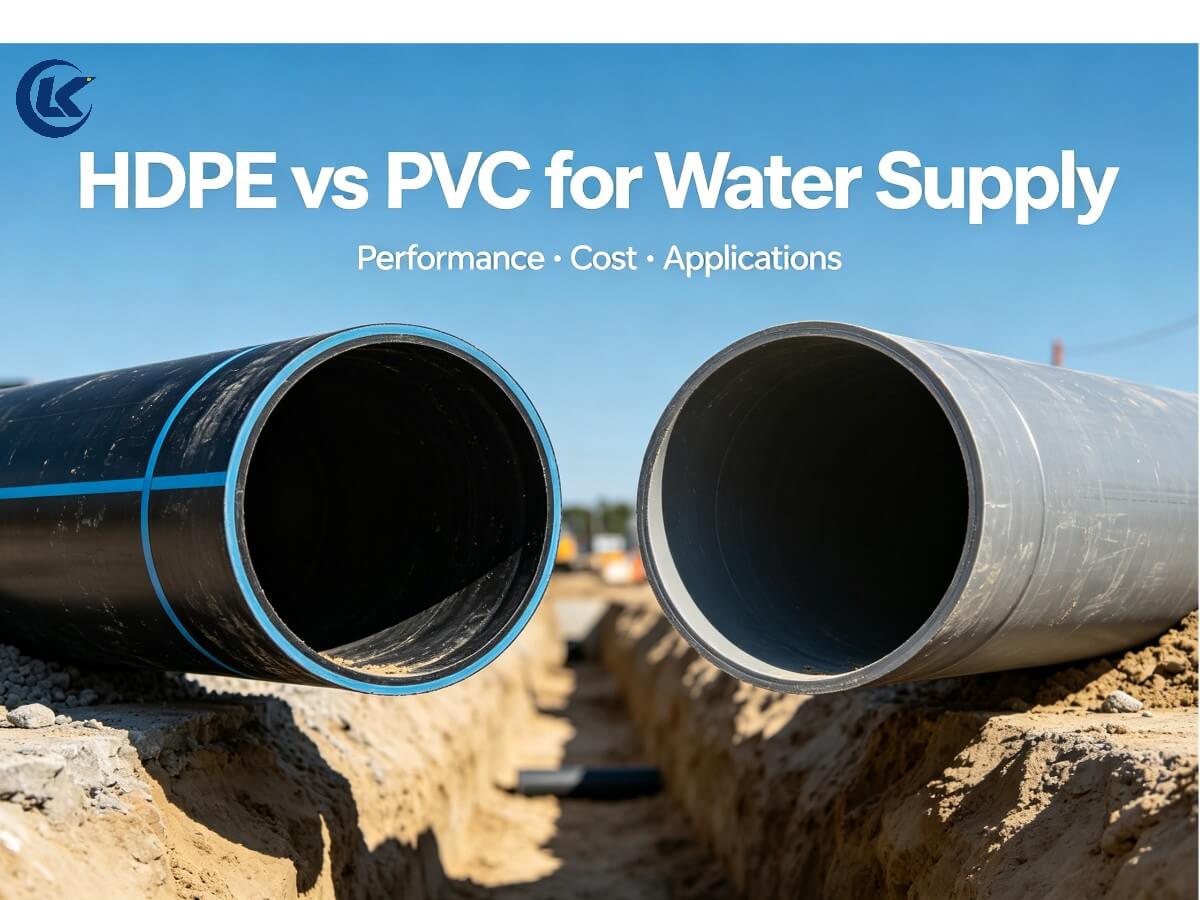
HDPE pipes are manufactured primarily from high-density polyethylene resin, exhibiting excellent flexibility, impact resistance, and corrosion resistance. Their stable molecular structure enables them to withstand significant temperature fluctuations and ground settlement, so they perform exceptionally well in complex terrain or challenging geological conditions.
PVC pipes are produced using polyvinyl chloride resin as the base material. After modification, they deliver superior rigidity and structural strength. PVC pipes feature smooth surfaces, are lightweight for easy transportation, and have good acid and alkali resistance, making them widely adopted in municipal and building water supply systems.
In short, HDPE prioritizes flexibility and toughness, while PVC focuses on rigidity and structural stability.
In water supply systems, pipelines continuously bear internal water pressure, so pressure resistance is a critical evaluation factor. HDPE pipes have outstanding crack resistance and strong tolerance for slow crack growth, resisting brittle fracture even under long-term pressurized operation. HDPE provides notable safety advantages, especially for pipe networks prone to water hammer or large pressure fluctuations.
PVC pipes also have reliable pressure ratings. Standard PVC-U water supply pipes can meet the requirements of conventional municipal water distribution systems. However, PVC’s toughness declines in low-temperature environments, and it is vulnerable to impact cracking. Protective measures are therefore required in cold climate regions or areas exposed to frequent external mechanical impact.
With proper design and installation, both HDPE and PVC pipelines can achieve a service life exceeding 50 years. HDPE, however, shows better long-term fatigue resistance and resistance to environmental stress cracking.
HDPE pipes generally adopt butt fusion or electrofusion. This process fuses pipe and fitting material into an integrated whole, forming a fully sealed, leak-free pipeline system. Fusion joints deliver exceptional sealing performance, ideal for buried municipal water mains. They effectively reduce leakage rates and cut long-term maintenance costs.
PVC pipes mainly use rubber-ring socket joints or solvent cement bonding. Rubber-ring connections enable fast installation and suit medium & small diameter pipe projects; solvent cement bonding is commonly used for indoor building water supply. Although PVC joints are convenient to install, their overall structural strength is lower than HDPE fused joints. Under uneven foundation settlement or continuous vibration, joint stability is relatively weaker.
For long-distance water transmission or water supply systems requiring high reliability, HDPE’s joint advantages become very prominent.
HDPE pipes are lightweight and highly flexible. Small-diameter HDPE can be supplied in coils, reducing joint quantities and boosting construction efficiency. The material can follow curved routes and supports trenchless construction, such as crossing roads, rivers and mountainous zones, lowering overall construction complexity.
PVC pipes have higher rigidity and are supplied in straight lengths, requiring more joints and directional fittings. PVC installation remains efficient for projects with stable trench conditions and simple routing. Cutting and assembly are straightforward, with fewer requirements for heavy construction equipment.
HDPE is preferred for complex construction environments, frequent direction changes, pipe jacking and pull-in installation. PVC becomes the more economical option when construction conditions are standardized and pipeline routes are linear.
In terms of raw material procurement, PVC pipes are normally cheaper than HDPE pipes of equivalent specifications, making them attractive for budget-limited projects. They are widely used for low-to-medium pressure water supply branch lines, building water supply and general rural drinking water projects due to price competitiveness.
HDPE carries a higher upfront material cost. Still, its lifecycle cost is often favorable thanks to low joint leakage, minimal maintenance, and strong adaptability to ground movement. For large municipal water mains and regions where frequent repairs are costly, HDPE delivers better overall economic value.
To sum up: PVC wins on initial investment. If long-term operation and maintenance are considered, HDPE often proves the more worthwhile investment.
Water supply systems directly relate to drinking water safety, so sanitary performance of pipe materials is critical. Qualified HDPE water supply pipes do not release harmful substances. Their smooth inner wall prevents scale buildup and helps preserve water quality.
Premium PVC water supply pipes can also meet drinking water transport requirements when produced with food-grade raw materials and stabilizers compliant with potable water standards. Poor-quality PVC products may create potential safety risks. Always source from reputable manufacturers with complete certification.
Environmentally, HDPE has a relatively high recycling rate. Recycling and reprocessing of PVC is more complicated by comparison.
Both HDPE and PVC pipes are mature, reliable materials widely used in modern water supply engineering. There is no absolute “superior” choice — the key is matching pipe performance to project conditions.
HDPE’s high flexibility, reliable fused joints, impact resistance and outstanding durability make it better suited for high-standard, demanding water supply systems. PVC, with advantages in low cost, high rigidity and simple installation, offers strong practical value for standard water supply projects.
Material selection should comprehensively consider water transmission pressure, geological conditions, budget limits, construction methods and future maintenance needs. Only by selecting the proper pipe material based on actual project conditions can the water supply system operate safely, economically and stably over its full service life.
For technical support and project-specific quotation, please contact our team.

